What is Rear Mirror Test and How Does It Impact User Experience?
The "Rear Mirror Test" serves as a critical benchmark in user experience evaluation. This innovative approach allows designers to gain insights into user emotions and attitudes. According to Dr. Sarah Thompson, a recognized expert in user experience research, "The Rear Mirror Test opens a window into how users perceive and interact with products."
This test provides valuable feedback that can improve design. By understanding users' reflections on their experiences, designers can create more engaging and intuitive interfaces. Yet, relying solely on user feedback is not enough. Some insights may reveal biases and misinterpretations in user responses.
Moreover, the Rear Mirror Test is not a one-size-fits-all solution. Its effectiveness can vary across different user groups and contexts. Acknowledging these limitations is essential for refining our approach to design. Balancing user input with expert analysis remains crucial in crafting solutions that truly resonate with users.

What is the Rear Mirror Test?
The Rear Mirror Test is a thought-provoking concept in user experience design. Essentially, it involves analyzing how users interact with a digital product, akin to looking in a rearview mirror. This test aims to capture a user’s behavior after they have completed a task. It helps to identify if they feel satisfied or confused. By reflecting on past actions, designers can uncover insights about navigational ease and functionality.
This test can reveal unexpected user frustrations. For example, users might struggle to locate a button they previously clicked. Such findings are crucial for improving user interfaces. They force designers to rethink layout and accessibility. Observing users as they look back on their interactions provides essential data. Sometimes, what seems intuitive may not be. A misplaced button or unclear instructions can lead to a negative experience. This encourages a cycle of re-evaluation and enhancement.
Overall, the Rear Mirror Test emphasizes understanding user journeys. It highlights the need for ongoing feedback. Designers must be open to adapting their approaches. Continuous reflection on user experiences leads to better products. The process is complex and requires careful observation. Each iteration is a step toward improved usability.
What is the Rear Mirror Test and How Does It Impact User Experience?
| Test Aspects |
Description |
Impact on User Experience |
Example Application |
| Clarity |
The test measures how clearly users can see information mirrored back to them. |
Improved clarity leads to better decision-making and user satisfaction. |
Dashboard design in analytics tools. |
| Intuitiveness |
Evaluates how naturally users understand and navigate the interface. |
Enhancing intuitiveness reduces cognitive load, making tasks smoother. |
Mobile app navigation. |
| Feedback |
Assesses how well the system provides feedback to user actions. |
Effective feedback boosts user confidence and reduces uncertainty. |
E-commerce checkout process. |
| Responsiveness |
Measures how quickly the system responds to user inputs. |
Fast response times enhance user satisfaction and retention. |
Online gaming interfaces. |
Historical Background of the Rear Mirror Test
The Rear Mirror Test dates back to early user experience studies. Researchers aimed to evaluate how users interact with systems. The test focuses on how well users can perceive information in a quick glance. This concept became significant as technology advanced.
Historically, the rear mirror serves as a metaphor for evaluating past experiences. In automotive design, its function is clear: ensure safety while driving. Similarly, in digital interfaces, a “rear mirror” approach prompts designers to consider intuitive layouts. Simple designs capture attention faster.
Despite its effectiveness, the rear mirror test has limitations. Not all users interpret interfaces in the same way. Some may overlook critical details while focused elsewhere. Designers must constantly reflect on user diversity. Continuous adaptation is essential for improving overall user experience. This challenge keeps the conversation around usability alive.
Key Principles Behind the Rear Mirror Test
The Rear Mirror Test is a fascinating concept that aims to enhance user experience by examining how users perceive their journey within a product or service. The key principle behind this test is to reflect on past interactions and identify areas for improvement. By looking back, designers can discover patterns in user behavior and understand what worked well and what didn’t. This reflection provides insightful data, guiding future design decisions.
For instance, consider a user navigating a mobile app. If the app fails to offer clear pathways, the user may feel lost. The Rear Mirror Test helps identify why that confusion occurred. Was there an unclear menu? Did they miss important notifications? Engaging users in this reflective practice fosters a deeper understanding of their needs. It enables designers to create intuitive interfaces that resonate with users.
Performing the Rear Mirror Test doesn’t guarantee instantaneous success. There can be challenges, such as collecting honest feedback from users. Some individuals may hesitate to share their true experiences. Acknowledging these imperfections is crucial. Encouraging open dialogue and iterative testing can lead to more reliable insights. The Rear Mirror Test ultimately shapes a better user interface, but it requires continuous effort and reflection.
Importance of User Experience in the Rear Mirror Test
The Rear Mirror Test is a fascinating concept in user experience design. It evaluates how users reflect on their interactions with a product or service. This retrospective assessment can reveal crucial insights into the user journey. Understanding these insights is vital for improving user experience.
Reflecting on experiences enables designers to identify pain points. For example, users might feel frustrated if navigation is confusing. Such feelings can lead to negative word-of-mouth. Ensuring a seamless experience is key to user retention.
Tips for improving user experience include gathering feedback regularly. Conduct surveys to understand user feelings. Observe interactions to see where users struggle. Also, keep testing variations to see what resonates. The Rear Mirror Test isn’t just about looking back; it’s a tool for future enhancements. Prioritizing user feedback helps in creating intuitive designs. Remember, small adjustments can lead to significant improvements over time.
User Experience Metrics in Rear Mirror Test
Applications of the Rear Mirror Test in Design and Development
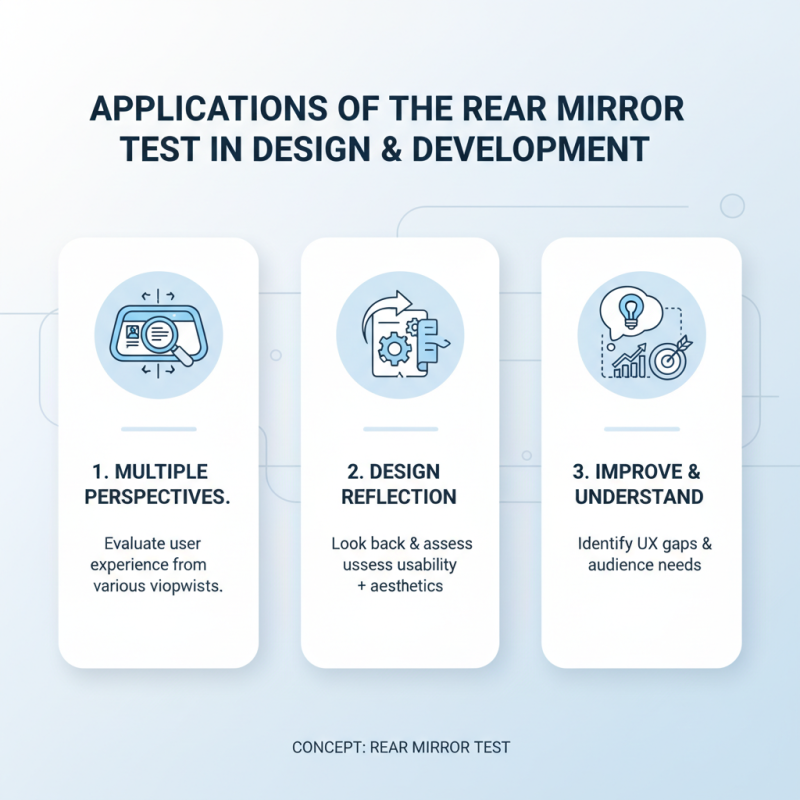
The Rear Mirror Test is a concept that emphasizes the importance of evaluating user experiences from multiple perspectives. In the design and development field, this test encourages teams to reflect on their design choices. It asks designers to look back at their work, assessing the overall usability and aesthetic appeal. This self-reflection helps identify gaps in user experience and fosters a deeper understanding of audience needs.
Applying the Rear Mirror Test can enhance product design significantly. For example, it can be used in app development. Designers can revisit an app's interface after several iterations. They might notice that certain features are less accessible than intended. Gathering feedback from real users during this process is crucial. Observing how users interact can unveil unexpected issues, guiding further refinements.
This approach is also valuable in physical product design. A team might develop a consumer product, only to find that the packaging is challenging to open. Such insights, gained from the Rear Mirror Test, lead to vital adjustments. While teams may strive for perfection, this process often reveals areas requiring improvement. Recognizing these imperfections can turn into an opportunity for growth and innovation in future projects.