Leave Your Message

How to Choose the Best Stepper Gears for Your Projects?

Choosing the right stepper gears can significantly impact the success of your projects. According to a recent report by the Robotics Industry Association, the demand for efficient stepper gears has increased by 30% over the past three years. Expert engineer Dr. John Thompson states, “The choice of stepper gears can enhance precision and overall performance.” This highlights the importance of understanding the various types and specifications available.

When selecting stepper gears, consider factors such as torque, speed, and material. Opting for high-quality gears can prevent frequent malfunctions. A survey by Tech Publications found that nearly 25% of projects fail due to improper gear selection. Many designers overlook the intricate details that can lead to serious issues. Mistakes can be costly.

Ultimately, make informed decisions based on credible data. Engage with industry-specific reports before finalizing your selection. Thoughtful consideration of the right stepper gears can lead to enhanced performance and efficiency in your projects. Being meticulous in your choices will pay off in the long run.

How to Choose the Best Stepper Gears for Your Projects?

Factors to Consider When Choosing Stepper Gears for Projects

Selecting the right stepper gears for your projects requires careful consideration. Begin by evaluating the torque requirements of your application. Knowing how much force is needed will guide you in choosing gears that can handle the load effectively. If the gears are not capable, your project could fail to perform optimally.

Another vital factor is the required precision. Gear backlash can impact accuracy. Low backlash gears are better for applications requiring high precision, such as robotics or CNC machines. Think about your project's complexity. A simple design might work with standard gears. However, intricate mechanisms may require custom solutions, which can be more costly and time-consuming.

Material choice also plays a critical role. Gears made from sturdy materials like steel or aluminum offer durability. Yet, they may add weight to your design. Consider the trade-off between strength and weight. Lastly, remember to account for compatibility with motors. Ensure that the gear dimensions match the motor specifications perfectly. Inspecting all these details can simplify your selections and enhance your project's success.

Understanding the Different Types of Stepper Gears and Their Applications

How to Choose the Best Stepper Gears for Your Projects?

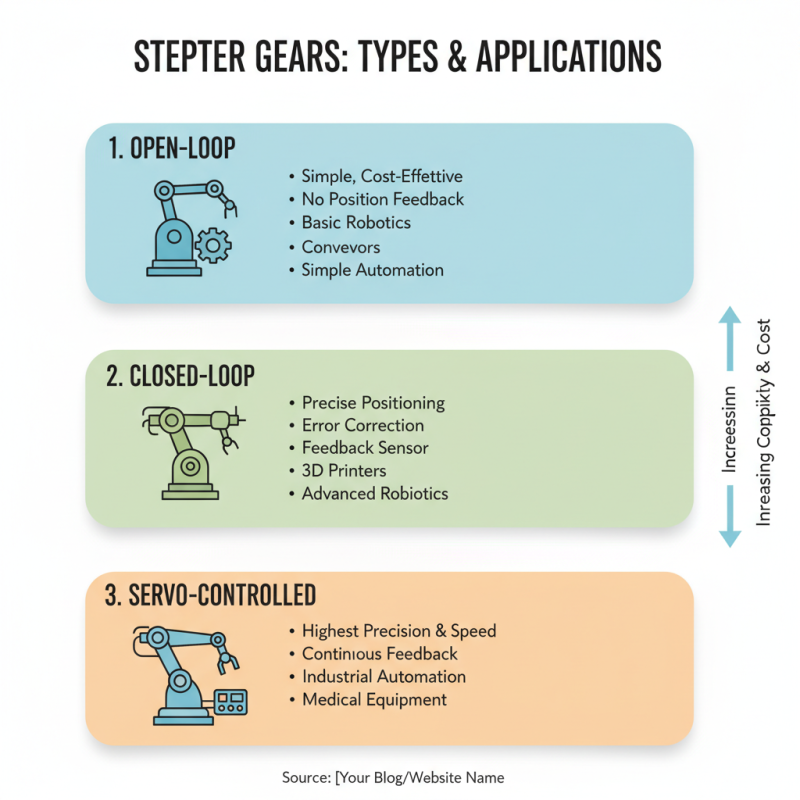
When choosing stepper gears, it is vital to understand their types and applications. Stepper gears typically fall into three categories: open-loop, closed-loop, and servo-controlled. Each type serves different project needs. Open-loop systems are simpler and more cost-effective. They work well for applications that do not require precise positioning, such as basic robotics.

Closed-loop systems, in contrast, offer greater accuracy and performance. According to a study by the International Journal of Advanced Manufacturing Technology, these systems increase efficiency by nearly 30% in specific applications. They incorporate feedback mechanisms, ensuring that the system can correct its position in real-time. This is crucial in automated assembly lines where precision is key.

Servo-controlled stepper gears combine the advantages of both systems. They provide high torque and speed control. However, their complexity can lead to longer setup times. Projects that require accurate motion control often benefit from these advanced systems. Understanding these distinctions helps in selecting the right stepper gear for your specific needs. Be aware, however, that with greater capability often comes increased cost and potential for failure if not properly tuned.

Evaluating Torque and Speed Requirements for Your Stepper Gear System

When selecting stepper gears for your projects, evaluating torque and speed is crucial. Torque determines the force that the gear system can handle. According to a 2022 industry report, optimal torque levels range from 0.1 to 1.5 Nm for small-scale applications. Understanding your project’s needs helps ensure you select the right torque specifications.

Speed requirements also play a vital role. Typically, stepper motors operate at speeds between 100 to 1000 RPM. Depending on the application, you may need to adjust this range. A mismatch in speed and torque can lead to inefficient performance. If the system operates too slowly for your application, it can result in longer operation times and reduced efficiency.

In some cases, achieving the perfect balance of torque and speed is not straightforward. Many engineers overlook the potential of backlash in their design. Backlash can reduce precision and make systems less reliable. Careful calculations and real-world testing are essential to refine your setup. It’s worth reviewing your gear system periodically to ensure it meets the evolving needs of your projects.

Key Materials and Manufacturing Techniques in Stepper Gear Production

How to Choose the Best Stepper Gears for Your Projects?

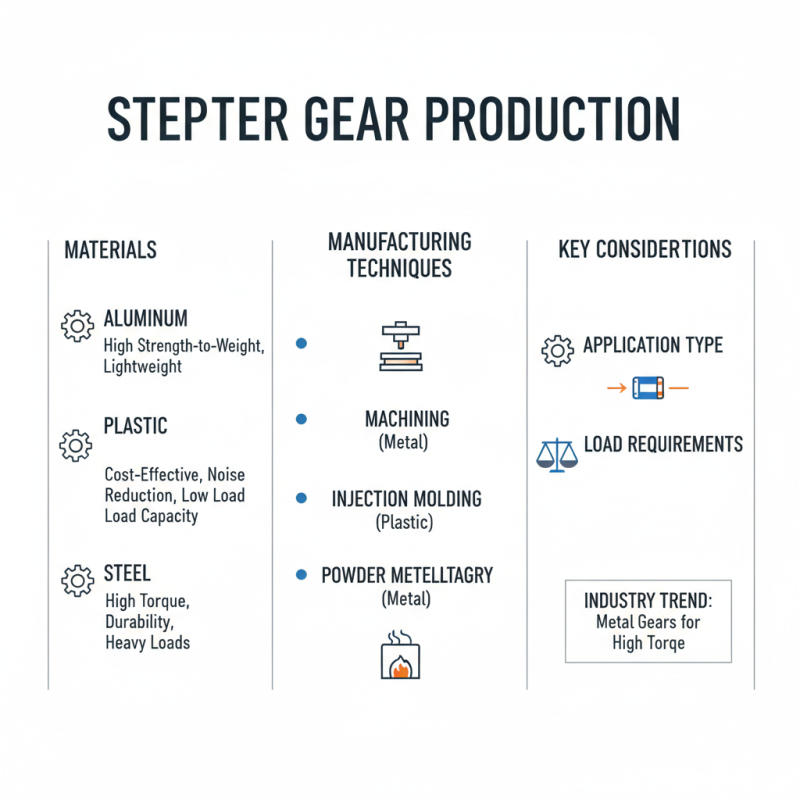
When selecting stepper gears, understanding the key materials and manufacturing techniques is critical. Common materials include aluminum, plastic, and steel. Aluminum offers a high strength-to-weight ratio, making it ideal for lightweight applications. Plastic gears, on the other hand, are cost-effective and can reduce noise in operations. However, they may not withstand heavy loads, leading to wear and tear. Recent industry reports suggest that metal gears are preferred for higher torque applications due to their durability.

Manufacturing techniques also play a significant role in gear quality. Precision machining is common, allowing for detailed and accurate designs. For example, Computer Numerical Control (CNC) machining provides excellent tolerances. However, this method can be costly. Another technique, injection molding, is efficient for producing plastic gears. It facilitates mass production but may compromise some dimensional accuracy. Addressing these trade-offs in gear selection can enhance performance. Industry data highlights that about 30% of failures in gear mechanisms arise from material selection. Therefore, careful consideration is essential in stepper gear design.

Industry Standards and Specifications for Reliable Stepper Gear Selection

Choosing the right stepper gears for your projects requires understanding industry standards. The proper selection can significantly impact performance. According to the Robotics Industry Association, over 70% of project failures relate to gear miscalculations. This highlights the necessity of using reliable specifications.

Key specifications include torque ratings and gear reduction ratios. Standard torque ratings often range from 0.5 to 2.0 Nm for many applications. However, projects requiring higher precision may need specialized gears. A report from the International Society of Automation emphasizes the importance of seamless gear engagement. Any misalignment can lead to increased wear and tear.

Material choice is another critical factor. Common materials include nylon, steel, and aluminum. Each has distinct benefits and limitations. For example, nylon is lightweight and less durable under heavy loads, while steel offers strength but adds weight. Evaluating these materials against project requirements is essential for long-term reliability. Consideration of lifecycle costs and maintenance needs is often overlooked but can reveal critical insights.

How to Choose the Best Stepper Gears for Your Projects?

Gear Type Material Input Torque (Nm) Efficiency (%) Reduction Ratio Max RPM Application
Planetary Aluminum 1.5 90 10:1 3000 Robotics
Spur Steel 2.0 85 5:1 2000 Conveyor Systems
Worm Bronze 1.2 75 20:1 1000 Elevators
Bevel Plastic 0.8 80 3:1 2500 Automated Furniture