Top 10 Best Servo Motors for Precision Control and Performance?
Servo motors are essential components in precision control systems. Experts like Dr. Emily Chen, a renowned authority in automation, once said, "The right servo motor can make or break your project's success." This statement resonates deeply in industries relying on accuracy and performance.
In today's market, choosing the best servo motor can be daunting. With numerous options, selecting one can lead to mistakes. Not all motors are created equal. Some may not meet the precision required for specific applications. Understanding the unique features of each model is crucial. Factors such as torque, speed, and control options play vital roles.
Furthermore, the growing demand for robotics and automation increases the need for high-performance servo motors. The wrong choice can hinder productivity. Thus, evaluating the best options available is important. Precision control is key. However, it’s not always easy to find the right fit. Rethinking our approach may lead to more informed decisions.

Understanding Servo Motors: Definition and Working Principles
Servo motors are essential components in various applications requiring precision control. These motors convert electrical energy into mechanical energy. They function based on feedback mechanisms to provide accurate positioning. Typically, they consist of a motor, a gearbox, and sensors. The motor drives the system, while the gearbox multiplies the torque. Sensors measure the motor's position, ensuring accurate control.
When choosing a servo motor, consider factors like torque and speed. It's crucial to match the motor's specifications to your project's needs. An inefficient choice can lead to performance issues.
Tips: Always double-check the expected load. Testing is essential. Forgetting this can result in underperformance.
Understanding the control system is vital too. Closed-loop systems provide more accuracy than open-loop systems. However, they can be more complex to set up. Don't rush through this part of your project.
Sometimes, the calibration process may feel tedious. But it’s essential for optimal performance. Take your time to ensure everything is correctly aligned. Otherwise, you may encounter issues down the line. Balancing precision and ease of use can lead to better overall results in your applications.
Top Criteria for Precision Control in Servo Motors
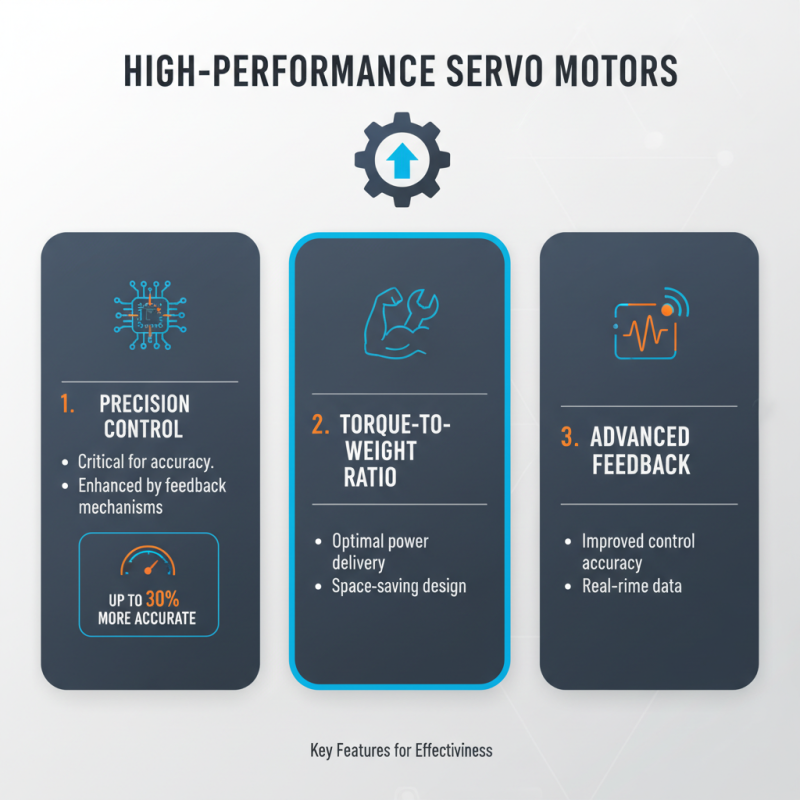
When searching for precision in servo motors, several key criteria stand out. A critical aspect is the feedback mechanism. High-quality encoders enhance positional accuracy significantly. This precision impacts applications in robotics, CNC machines, and automation systems. Servo motors with closed-loop control systems provide better reliability and responsiveness. They adapt in real-time, which can be vital in dynamic environments.
Another essential criterion is torque performance. The ability to maintain torque under varying loads is crucial. High torque at low speeds can be particularly valuable for intricate tasks. The design of the motor also plays a role. Smaller, lightweight designs may be beneficial for compact applications, but they often come with trade-offs in power capacity. Users must consider these factors carefully.
Moreover, thermal management cannot be overlooked. Overheating can lead to performance degradation. A cooling system or heat sink might be necessary for high-demand scenarios. Yet, adding components can complicate setups. Balancing simplicity with performance is an ongoing challenge. Each application presents different needs, and compromise is often unavoidable. Crafting a solution requires thorough consideration of all these criteria.
Comparison of the Leading Servo Motors in the Market
When selecting a servo motor, precision and performance are key. Various options exist, each with unique features. Some motors excel in speed, while others prioritize torque and accuracy. It's important to understand your needs and application specifics. For instance, a high-torque motor might not be the best fit for a lightweight, high-speed application.
Consider factors like size and weight. A compact motor may struggle in heavy-duty tasks. Conversely, a more robust option might be overkill for simpler jobs. Pay attention to feedback systems as well. Closed-loop systems provide enhanced control, but they can add complexity. Simplicity can sometimes facilitate easier integration into systems.
There are trade-offs everywhere. Higher precision often comes with lower speed. This can hinder performance in certain scenarios. Testing different models in actual conditions could reveal unexpected behaviors. It’s also crucial to verify compatibility with existing setups. Always take the time to analyze your options. Making the right choice can significantly impact overall efficiency.
Applications of Servo Motors in Various Industries
Servo motors are vital in many industries. They offer precision and reliability in various applications. For instance, in manufacturing, these motors control robotic arms. This enhances production speed and accuracy. Automating assembly lines reduces human error. However, not every application is seamless. Some setups lead to delays or malfunctions without proper calibration.
In aerospace, servo motors play a crucial role. They manage flight controls and landing gear operations. Safety is paramount here. Any failure can lead to dire consequences. Regular maintenance is essential, yet some technicians overlook this. In the automotive realm, servo motors assist in steering systems and automated parking. These innovations improve driver experience, yet some users report hesitations in response time.
In robotics, servo motors enable intricate movements. They allow for delicate tasks, like surgery or assembling small parts. Challenges arise when motors overheat or fail to respond accurately. Engineers must continuously test and refine their designs. Balancing performance with reliability is an ongoing challenge. Servo motors have immense potential, but they require diligent handling to reach their full effectiveness.
Top 10 Best Servo Motors for Precision Control and Performance
This chart displays the performance ratings of the top 10 servo motors for precision control and performance in various industrial applications. Each motor's rating is based on criteria such as responsiveness, accuracy, and reliability.